 Skip to content


Static Sign-Off
Maximizing design & functional verification efficiency for:
Real Intent static sign-off products lead the market in breadth, precision, performance, and capacity.
FAST

HCL used this methodology to successfully verify connectivity and glitches on an active SoC design using Real Intent’s SafeConnect in a few days.
This is in contrast to several weeks work required with alternative methods.
– Arun Selvaraju, HCLTech
PRECISE

STMicroelectronics ran Real Intent Meridian RDC and a competitive tool on a dual CPU subsystem with 150,000 gates, 15 clock domains, ~25,000 CDC paths and ~450,000 RDC paths.
Meridian RDC achieved a 25X reduction in noise, and a ~4X reduction in runtime and RAM usage.
– Julien Faucher, ST Microelectronics
USER EXPERIENCE

NVIDIA has been a customer of Real Intent since 2000. We are extremely happy with the products, they are a regular part of our flows, and the quality of technical support is excellent.
Real Intent is a reliable business partner for us because of their friendly business practice and dedication to make their customers successful.
– Dan Smith, NVIDIA







What is Static Sign-off?
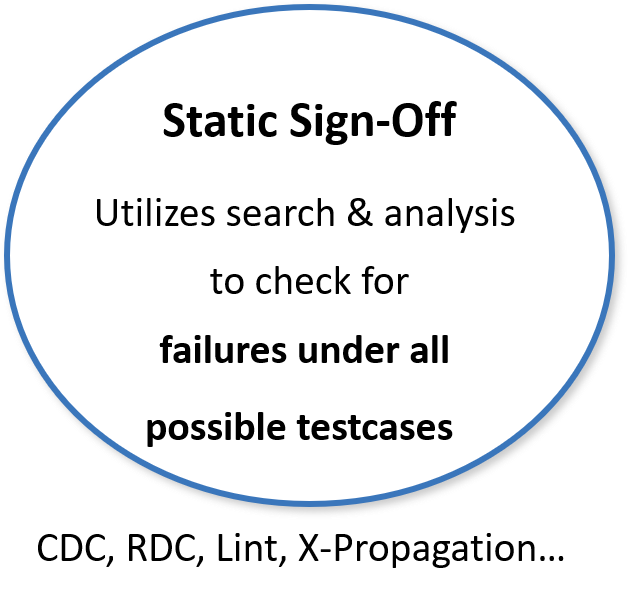
Static sign-off uses search and analysis to check for design failures under all possible test cases. Static sign-off technologies can address functional (Clock Domain Crossing, Reset Domain Crossing, Linting, X-Propagation, DFT, Connectivity, Glitch…), layout (DRC), and timing (STA) domains. Real Intent’s focus is functional static sign-off.
Real Intent provides intent-driven static sign-off tools to improve digital design efficiency by accelerating early functional verification .
Its product capabilities for eliminating complex SoC failure modes include: clock domain crossing sign off from RTL through gate level, including multimode CDC; reset domain crossing sign off, advanced RTL linting & analysis, and connectivity & glitch sign-off.
Real Intent products lead the market in breadth, precision, performance, and capacity, with more than 50 major semiconductor and systems company customers.