Blog Archive
May 2012
5/08/2012: Gabe on EDA: Real Intent Helps Designers Verify Intent
5/07/2012: EDACafe: A Page is Turned
5/07/2012: Press Release: Graham Bell Joins Real Intent to Promote Early Functional Verification & Advanced Sign-Off Circuit Design Software
March 2012
3/21/2012: Press Release: Real Intent Demos EDA Solutions for Early Functional Verification & Advanced Sign-off at Synopsys Users Group (SNUG)
3/20/2012: Article: Blindsided by a glitch
3/16/2012: Gabe on EDA: Real Intent and the X Factor
3/10/2012: DVCon Video Interview: “Product Update and New High-capacity ‘X’ Verification Solution”
3/01/2012: Article: X-Propagation Woes: Masking Bugs at RTL and Unnecessary Debug at the Netlist
February 2012
2/28/2012: Press Release: Real Intent Joins Cadence Connections Program; Real Intent’s Advanced Sign-Off Verification Capabilities Added to Leading EDA Flow
2/15/2012: Real Intent Improves Lint Coverage and Usability
2/15/2012: Avoiding the Titanic-Sized Iceberg of Downton Abbey
2/08/2012: Gabe on EDA: Real Intent Meridian CDC
2/08/2012: Press Release: At DVCon, Real Intent Verification Experts Present on Resolving X-Propagation Bugs; Demos Focus on CDC and RTL Debugging Innovations
January 2012
1/24/2012: A Meaningful Present for the New Year
1/11/2012: Press Release: Real Intent Solidifies Leadership in Clock Domain Crossing
August 2011
8/02/2011: A Quick History of Clock Domain Crossing (CDC) Verification
July 2011
7/26/2011: Hardware-Assisted Verification and the Animal Kingdom
7/13/2011: Advanced Sign-off…It’s Trending!
May 2011
5/24/2011: Learn about Advanced Sign-off Verification at DAC 2011
5/16/2011: Getting A Jump On DAC
5/09/2011: Livin’ on a Prayer
5/02/2011: The Journey to CDC Sign-Off
April 2011
4/25/2011: Getting You Closer to Verification Closure
4/11/2011: X-verification: Conquering the “Unknown”
4/05/2011: Learn About the Latest Advances in Verification Sign-off!
March 2011
3/21/2011: Business Not as Usual
3/15/2011: The Evolution of Sign-off
3/07/2011: Real People, Real Discussion – Real Intent at DVCon
February 2011
2/28/2011: The Ascent of Ascent Lint (v1.4 is here!)
2/21/2011: Foundation for Success
2/08/2011: Fairs to Remember
January 2011
1/31/2011: EDA Innovation
1/24/2011: Top 3 Reasons Why Designers Switch to Meridian CDC from Real Intent
1/17/2011: Hot Topics, Hot Food, and Hot Prize
1/10/2011: Satisfaction EDA Style!
1/03/2011: The King is Dead. Long Live the King!
December 2010
12/20/2010: Hardware Emulation for Lowering Production Testing Costs
12/03/2010: What do you need to know for effective CDC Analysis?
November 2010
11/12/2010: The SoC Verification Gap
11/05/2010: Building Relationships Between EDA and Semiconductor Ventures
October 2010
10/29/2010: Thoughts on Assertion Based Verification (ABV)
10/25/2010: Who is the master who is the slave?
10/08/2010: Economics of Verification
10/01/2010: Hardware-Assisted Verification Tackles Verification Bottleneck
September 2010
9/24/2010: Excitement in Electronics
9/17/2010: Achieving Six Sigma Quality for IC Design
9/03/2010: A Look at Transaction-Based Modeling
August 2010
8/20/2010: The 10 Year Retooling Cycle
July 2010
7/30/2010: Hardware-Assisted Verification Usage Survey of DAC Attendees
7/23/2010: Leadership with Authenticity
7/16/2010: Clock Domain Verification Challenges: How Real Intent is Solving Them
7/09/2010: Building Strong Foundations
7/02/2010: Celebrating Freedom from Verification
June 2010
6/25/2010: My DAC Journey: Past, Present and Future
6/18/2010: Verifying Today’s Large Chips
6/11/2010: You Got Questions, We Got Answers
6/04/2010: Will 70 Remain the Verification Number?
May 2010
5/28/2010: A Model for Justifying More EDA Tools
5/21/2010: Mind the Verification Gap
5/14/2010: ChipEx 2010: a Hot Show under the Hot Sun
5/07/2010: We Sell Canaries
April 2010
4/30/2010: Celebrating 10 Years of Emulation Leadership
4/23/2010: Imagining Verification Success
4/16/2010: Do you have the next generation verification flow?
4/09/2010: A Bug’s Eye View under the Rug of SNUG
4/02/2010: Globetrotting 2010
March 2010
3/26/2010: Is Your CDC Tool of Sign-Off Quality?
3/19/2010: DATE 2010 – There Was a Chill in the Air
3/12/2010: Drowning in a Sea of Information
3/05/2010: DVCon 2010: Awesomely on Target for Verification
February 2010
2/26/2010: Verifying CDC Issues in the Presence of Clocks with Dynamically Changing Frequencies
2/19/2010: Fostering Innovation
2/12/2010: CDC (Clock Domain Crossing) Analysis – Is this a misnomer?
2/05/2010: EDSFair – A Successful Show to Start 2010
January 2010
1/29/2010: Ascent Is Much More Than a Bug Hunter
1/22/2010: Ascent Lint Steps up to Next Generation Challenges
1/15/2010: Google and Real Intent, 1st Degree LinkedIn
1/08/2010: Verification Challenges Require Surgical Precision
1/07/2010: Introducing Real Talk!

The King is Dead. Long Live the King!

Pranav Ashar   Dr. Pranav Ashar
   CTO of Real Intent

The New Paradigm

Not long ago, functional simulation and static timing analysis was it for RTL verification. In fact, it was all that was needed because the inner-loop of computation and data-transfer on a chip was one synchronous block. As chip complexities grew and gate-level simulation became unviable, formal equivalence checking stepped in to pick up the slack with orders of magnitude improvement in productivity in comparing gate and RTL representations. But the paradigm remained the same even as the methods changed – verification still needed to cover only the functional input space as comprehensively and efficiently as possible.

Then, somehow, things changed under the hood. Computation on a chip got fragmented out of necessity and with significant consequences. An illustrative example of this trend is the multicore chip by Tilera, Inc. shown here, Inc. It is a 64-core processor with a number of high-speed interfaces integrated on chip.

Tile64 Processor Block Diagram

For one, it has become impractical to send a signal in one clock cycle from one end of the chip to another in one clock cycle, as well as to send the same clock to all parts of the chip with manageable and predictable skew. It is also energy inefficient and practically impossible to keep raising the clock frequency. Higher performance can increasingly only be achieved with application-specific cores or on-chip parallelism in processors. As a result, computation is being done increasingly in locally synchronous islands that communicate asynchronously with each other on chip. This was predicted some time ago, but is now truly coming to roost in the form of heterogeneous and homogeneous multicore chips. With fine-grain fragmentation, communication bandwidths and latencies between the computation islands have come under the design scanner, and protocols for transferring data and signaling between the islands are beginning to push the limits.

A second important change has been that energy and power optimization is now more aggressive than ever. Beyond parallelism-for-performance and custom cores, this trend has also brought once arcane design techniques into the mainstream. Each island runs at its optimal frequency, and dynamic control of clocks, clock frequencies and Vdd is now par for course.

Finally, chips are now true systems in that they integrate computation with real-world interfaces to peripherals, sensors, actuators, radios, and you name it. And, these interfaces must talk to the chip’s core logic at their own speeds and per their chosen protocols. Many of these interfaces are also pushing the performance limits of the core logic.

An apt analogy is that it is as if chips have transitioned from an orderly two-party political system to an Italian or Indian multi-party system in which the various parties must align with each other at periodic intervals to accomplish something and each party has its own chief whip to get the troops to toe the party line.

The implication of this trend on chip verification is that it has gotten messier – one can’t cleanly abstract timing from functional analysis any more, i.e., the functional space and the timing space must be explored together. Deterministic functional simulation with fixed clock frequencies and delays does not cover all failure modes, and static timing analysis neglects the dynamic and data dependent nature of interaction between clock domains in the presence of unrelated clocks and variability. We are still not in the world where we must timing-simulate everything, but the new complexity is daunting nevertheless.

The New Signoff Solution

In order to mitigate this complexity, it is essential that the verification tool first decipher design intent to localize the analysis requirements. This exercise also helps make debug more precise. To be sure, this is harder as optimizations get more aggressive – the boundary between computation and interface blurs and designers resort to ever more innovative techniques. Real Intent was prescient in predicting the new verification paradigm many years ago. After much experimentation and interaction with design companies, we have demonstrated that automatic and reliable capture of design intent is indeed viable for clock domain crossings.

The design intent step triages the design, finds many types of bugs, and sets up local analysis tasks and models (potentially with special algebras to capture the timing and variability effects) for further formal analysis and simulation. I call this the verification 4-step of intent extraction, formal analysis, simulation, all integrated into a systematic hierarchical approach of analysis and reporting for scalability.

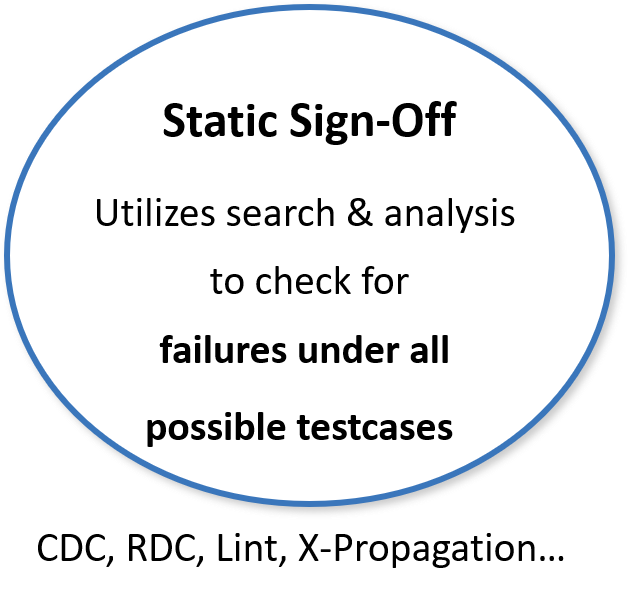
We find from our customers that the special verification requirement for clock domain crossings is now an essential part of the signoff process for all chips. Similar customized signoff is also called for in other contexts like DFT and power optimization for which failures cannot reliably be caught with functional simulation. Effectively, the old paradigm of “functional simulation + static timing analysis” is obsolete and the sign-off flow today looks more like the figure shown below:

Jan 3, 2011

blog comments powered by Disqus