Innovating the Intelligence of Formal Techniques for Automatic Design Verification
Blog Archive
July 2010
7/30/2010: Hardware-Assisted Verification Usage Survey of DAC Attendees
7/23/2010: Leadership with Authenticity
7/16/2010: Clock Domain Verification Challenges: How Real Intent is Solving Them
7/09/2010: Building Strong Foundations
7/02/2010: Celebrating Freedom from Verification
June 2010
6/25/2010: My DAC Journey: Past, Present and Future
6/18/2010: Verifying Today’s Large Chips
6/11/2010: You Got Questions, We Got Answers
6/04/2010: Will 70 Remain the Verification Number?
May 2010
5/28/2010: A Model for Justifying More EDA Tools
5/21/2010: Mind the Verification Gap
5/14/2010: ChipEx 2010: a Hot Show under the Hot Sun
5/07/2010: We Sell Canaries
April 2010
4/30/2010: Celebrating 10 Years of Emulation Leadership
4/23/2010: Imagining Verification Success
4/16/2010: Do you have the next generation verification flow?
4/09/2010: A Bug’s Eye View under the Rug of SNUG
4/02/2010: Globetrotting 2010
March 2010
3/26/2010: Is Your CDC Tool of Sign-Off Quality?
3/19/2010: DATE 2010 – There Was a Chill in the Air
3/12/2010: Drowning in a Sea of Information
3/05/2010: DVCon 2010: Awesomely on Target for Verification
February 2010
2/26/2010: Verifying CDC Issues in the Presence of Clocks with Dynamically Changing Frequencies
2/19/2010: Fostering Innovation
2/12/2010: CDC (Clock Domain Crossing) Analysis – Is this a misnomer?
2/05/2010: EDSFair – A Successful Show to Start 2010
January 2010
1/29/2010: Ascent Is Much More Than a Bug Hunter
1/22/2010: Ascent Lint Steps up to Next Generation Challenges
1/15/2010: Google and Real Intent, 1st Degree LinkedIn
1/08/2010: Verification Challenges Require Surgical Precision
1/07/2010: Introducing Real Talk!

Verification Challenges Require Surgical Precision

Pranav Ashar   Dr. Pranav Ashar
   CTO of Real Intent

It has been interesting to note that, per the Q3 2009 EDAC market survey, design companies continued to buy functional verification tools even through the recent downturn. The prognosis is that verification spending will continue to rise. While this is good news for EDA companies, it is also an indicator of the industry’s inability to contain the verification problem as design complexity continues to rise in terms of the number of transistors and the system-level functionality on a chip.

Newer chips have additional failure modes that were not issues before.  For example, approximately 85% of the designs today contain more than one clock domain. This is necessitated by a combination of clock-skew considerations as well as the diverse clocking requirements of system-level components on a chip. As a result, chip failures arising from improperly designed clock-domain crossings have become increasingly common. Similarly, low-power design techniques like clock gating and Vdd gating are also being used much more widely now, creating new failure modes that did not exist in previous chip generations.

Unfortunately for the design industry, there is no one-stop solution to the verification problem any more. While simulation has served the industry reasonably well thus far, its viability as the mainstay of the verification flow is being marginalized by the sheer complexity of checking for the newer failure modes. For example, using simulation to check clock domain crossings is not very effective given that these failures arise as a result of corner case confluences of timing and functionality.

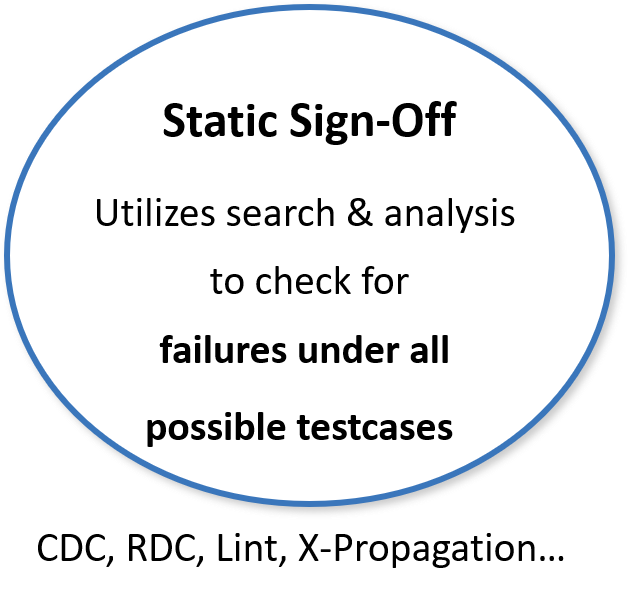
We believe what is required is that more attention be focused on identifying important productivity sinks to provide effective solutions targeting these specific, isolated and self-contained verification problems. Usually, the design principles involved are well understood and hence the characteristics of the specific error modes can be clearly identified.  Specialized and customized technologies that are based on synergetic integration of structural and formal techniques are the best solutions for detecting errors for these classes of issues.  A well known success story of applying specialized technology to solve a narrow problem has been the wide and easy adoption of equivalency checking between RTL and Gate representations.  Similarly, we believe that specialized technologies such as clock-domain crossing verification, low-power verification, X-behavior verification etc will also be widely embraced by the design community in the near term, making these tools an integral part of the design and verification flow.

The availability of these razor-sharp technologies targeting specific failure modes allows verification to be approached in a surgical manner with consequent improvements in design quality, productivity and return on investment. After all, even the best surgeon needs the right tools to be effective!

Jan 8, 2010

blog comments powered by Disqus